Your OCI Backup Is Not a Recovery Strategy
OCI resilience is an application workflow, not a collection of snapshots.

An object in a backup bucket is evidence of data preservation. It is not evidence that your business can operate after an outage.
I keep seeing disaster-recovery conversations start with backup frequency. That is an important discussion—but it is usually the wrong first discussion. A cloud application fails as a system: identity, networking, compute, persistent data, secrets, external connectivity, DNS, and the humans authorized to intervene. A backup protects only a subset of that system.
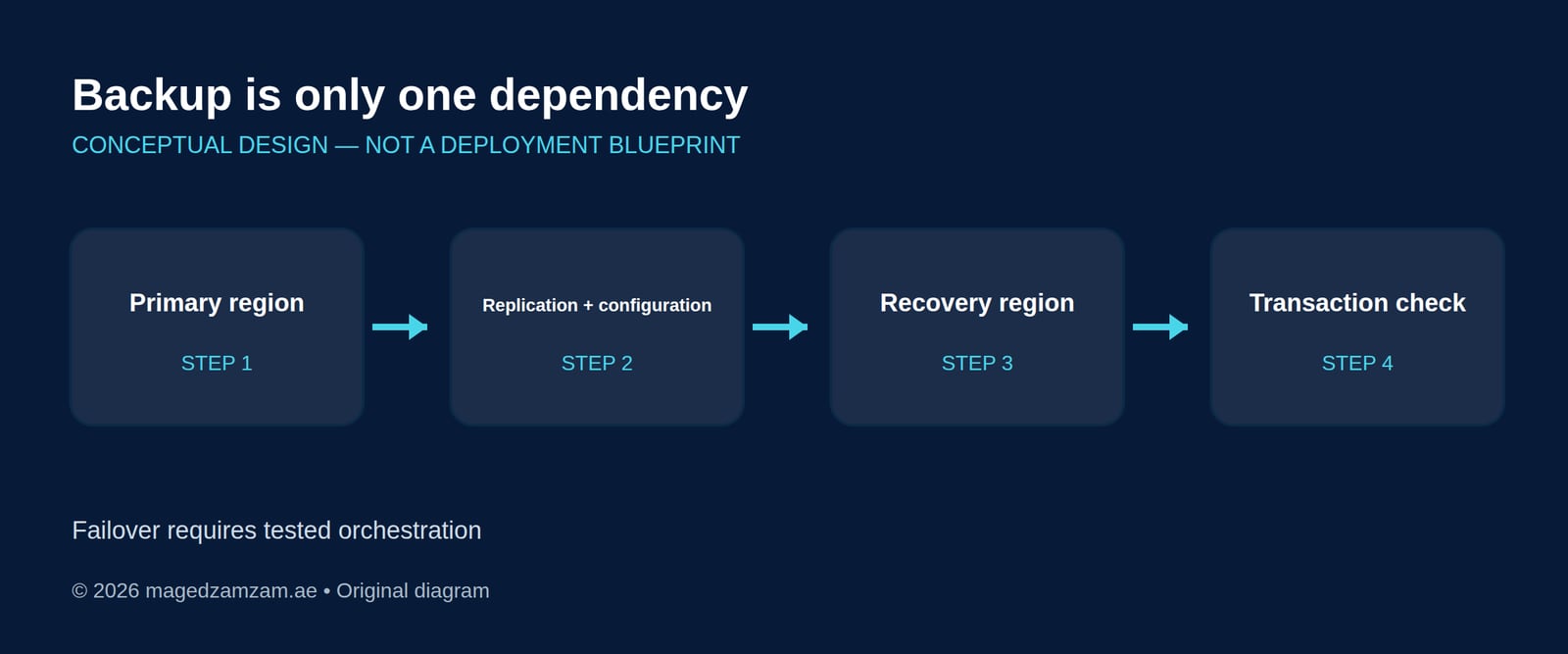
My position is simple: a recovery strategy deserves that name only when the team has demonstrated a complete, timed restoration of a business transaction. Anything less is an inventory of hopeful dependencies.
Start with the transaction, not the virtual machine
Imagine a booking API backed by a database. The database snapshot is valid, but the application cannot authenticate to the recreated database because a secret was rotated. The virtual machines boot, but the security lists and routes in the recovery environment do not admit traffic. The login screen appears, yet the payment callback points to the failed region. From a backup dashboard, everything is green. From a customer perspective, the service is unavailable.
Describe recovery in a dependency chain:
- Ingress: DNS, certificates, load balancer, API endpoints and partner allowlists.
- Execution: compute or Kubernetes, images, configuration and secrets.
- State: database replication or restore, object and file storage, transactional consistency.
- Trust: IAM policies, keys, vault access and audit trails.
- Validation: a synthetic transaction that proves the recovered system produces the right outcome.
The last point is the one most often missed. A successful boot is not a recovered service.
What OCI can orchestrate—and what it cannot decide for you
Oracle Cloud Infrastructure Full Stack Disaster Recovery provides orchestration for application recovery across infrastructure and database layers. Its documented workflow involves grouping dependencies, preparing DR plans, adding custom steps, verifying plans and executing rehearsed operations. Supported OCI resource types and deployment restrictions are documented and should be checked for the specific stack. [1][2]
That is a meaningful capability, but it is not a substitute for architecture. You still need to decide whether a workload warrants cross-region resilience, what is replicated or recreated, how secrets move, which external dependencies remain single-region, and what data loss the business will accept.
RPO is the maximum tolerable data loss measured in time. RTO is the maximum tolerable time to restore a service. Neither is achieved merely because a product supports a feature. They are achieved—or missed—by the end-to-end design and its operational execution.
A practical recovery contract
For each critical service, write a recovery contract with five fields: business transaction, owner, RPO, RTO, and the evidence produced by the most recent test. Then add the details that make the contract executable:
| Concern | Specific question to answer |
|---|---|
| Consistency | Which database writes and downstream events must move together? |
| Dependencies | Which IAM, keys, registries, DNS and third-party connections must survive? |
| Activation | Who authorizes failover, and how is split-brain prevented? |
| Verification | Which synthetic customer journey must complete successfully? |
| Reversal | How do we safely return to the original topology after recovery? |
For a reservation platform, the synthetic journey could create a test reservation, read it via a second service, and verify that the expected notification or event was emitted. Run it using safe test data, not real guest records.
Practice failure rather than celebrating a precheck
A non-disruptive precheck can detect missing prerequisites, and OCI Full Stack DR includes plan verification and readiness capabilities. [2] But a precheck does not prove that an upstream payment provider can reach your relocated endpoint. At least periodically, exercise a controlled failover or isolated recovery rehearsal that crosses application boundaries.
Track four measurements: elapsed recovery time; observed data age at recovery; number of human interventions; and number of critical business transactions that passed. Include the unsuccessful attempts. They are often more informative than the successful run.
A useful cadence is to test small changes frequently and run full application recovery drills at a frequency derived from business criticality. Never stage a disruptive exercise without change control and a documented rollback path.
The uncomfortable economics of resilience
Cross-region capacity, replication, egress, and operations cost money. So does downtime. The responsible trade-off is neither “replicate everything” nor “back up everything.” Tier services by consequence. A brochure site may tolerate restoration from infrastructure-as-code and object copies. A revenue-critical transaction engine may require continuously replicated state, a prepared recovery environment, and strict operational drills.
Resilience also includes honest exclusions: a dependency outside your control can invalidate your RTO. Publish that dependency rather than burying it in a diagram.
The cloud makes recovery tooling more accessible. It does not make recovery automatic. Stop asking whether the backup succeeded. Ask when the complete business transaction last succeeded after a deliberate failure.
Related: A backup you haven’t restored is a hope, not a backup — the incident that taught me to ask when did you last restore this?
Sources
[1] Oracle: How Full Stack Disaster Recovery Works
[2] Oracle: Disaster Recovery in the Cloud Adoption Framework
More notes

Hotels Need an Event Backbone, Not Another Dashboard
A vendor-neutral hospitality integration pattern using OCI APIs, streaming and operational data governance.

A backup you haven't restored is a hope, not a backup
What recovering a corrupted HR system with zero data loss in a day and a half taught me — and the HA/DR checklist I now use for every design.

Let's Build It: A Hands-On Agent-to-Agent Walkthrough
Part 9, the finale of AI From Zero to Agents. We build three small agents (a trip planner, a currency agent and a weather agent) that find each other through A2A Agent Cards and work together over the A2A protocol, and read the real messages they exchange.