AI Infrastructure Is Becoming an Energy Business
A practical framework for evaluating AI infrastructure through power, siting, utilization and financial risk.

The next AI bottleneck may have more to do with electrical transformers and permits than model parameters.
Technology strategy has a habit of discussing compute as though it can be provisioned with a purchase order. GPU capacity can be ordered. A power connection, substation upgrade, cooling plant and suitable site cannot always be accelerated on the same schedule. That mismatch is changing how I think about AI infrastructure.
My thesis: the competitive advantage in AI infrastructure is increasingly an exercise in energy access, delivery discipline and asset utilization—not only chip ownership. This is not an argument that software innovation has stopped mattering. It is an argument that physical constraints have become first-class variables in the technology roadmap.
Read the electricity forecast correctly
The International Energy Agency's 2025 Energy and AI analysis estimates data centers consumed roughly 415 TWh of electricity in 2024 and projects around 945 TWh in 2030 in its base case. That is a scenario, not a guaranteed outcome; the IEA explicitly models uncertainty around AI uptake, hardware efficiency and energy constraints. [1]
The numbers matter because they reveal the physical scale of the undertaking. More efficient chips may reduce energy per task while lower costs drive more usage—the familiar rebound question. Demand is not the same as installed capacity, and an announcement is not the same as an energized building.
When I see a multi-billion-dollar infrastructure statement, I want to know what fraction of the project has land, grid interconnection, committed power, cooling design, hardware delivery and paying utilization. A headline capex figure answers none of those questions.
A better infrastructure scorecard
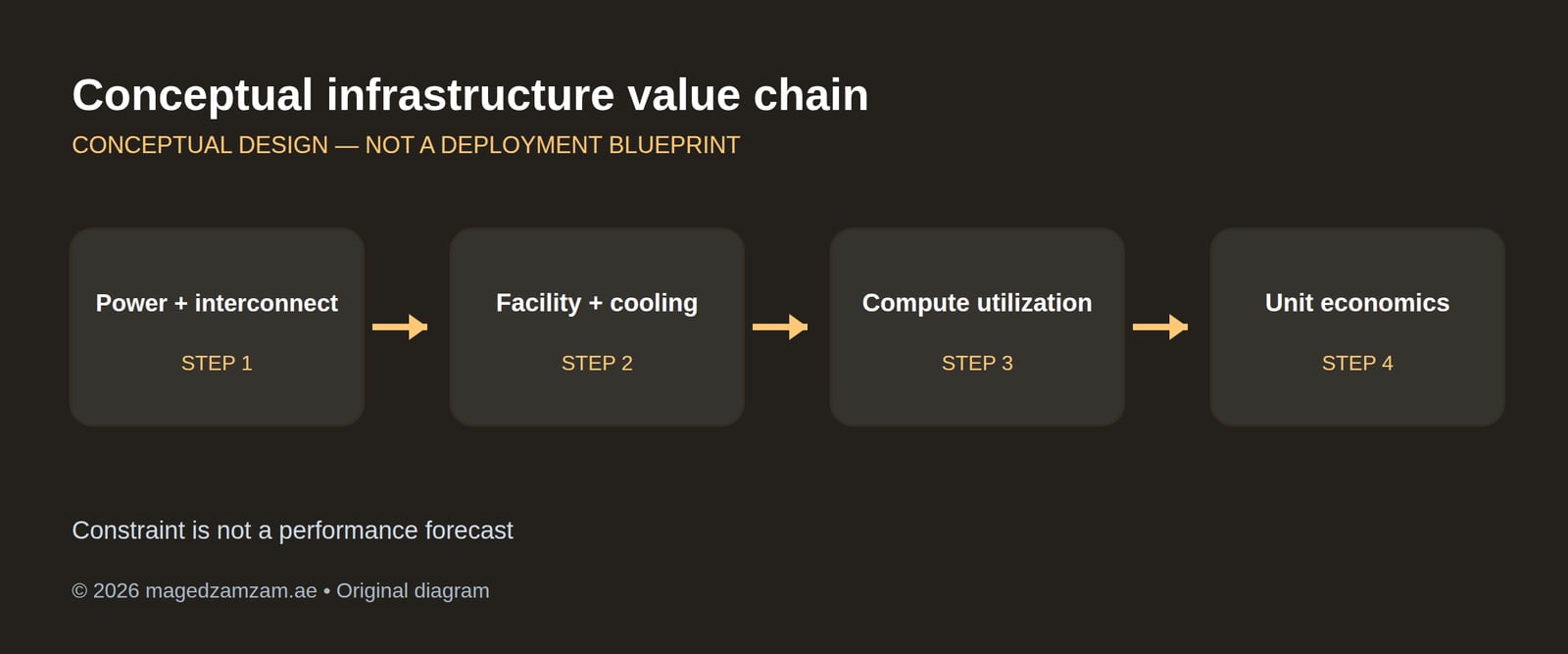
I would evaluate projects through five linked constraints:
| Constraint | Decision-relevant question |
|---|---|
| Power | Is electricity available on the actual required timeline and tariff? |
| Thermal | Can cooling meet rack density and local water or climate constraints? |
| Network | Are fiber routes, latency and redundancy appropriate for the workloads? |
| Finance | Can contract duration and revenue support rapidly depreciating assets? |
| Utilization | Will meaningful paid workloads occupy the hardware throughout its life? |
A project can have excellent GPUs and weak economics. Accelerators depreciate technologically; power and land investments have different timelines. A high advertised utilization rate can also conceal workloads that have very different margins and scheduling characteristics.
The geographic trade-off is getting harder
Training workloads may tolerate location flexibility if data movement and cluster topology allow it. Interactive inference for consumer or enterprise applications cares more about latency, data governance and proximity to users. Regulated workloads can face additional jurisdictional and audit requirements. Consequently, “build where power is cheap” is an incomplete rule.
The optimal site depends on a workload portfolio. For training, throughput and energy contract terms may dominate. For inference, latency, serving economics and data locality can shift the decision. For a hybrid enterprise platform, operators may need regional inference capacity plus a separate pool for large-scale experimentation.
Avoid two misleading narratives
The first misleading narrative says that AI demand will grow forever at any price. The second says infrastructure spending must be a bubble because the capital requirement is enormous. Both skip the hard questions: the unit economics of each workload, the structure of financing, and the possibility that technical efficiency changes demand faster than assets can be repurposed.
Even the strongest demand story can produce poor returns for an individual asset if it is deployed late, financed expensively, or locked into unfavorable contracts. Conversely, a well-sited and flexible facility can retain value across several compute generations. The market should be judged on the distribution of those outcomes rather than one dramatic valuation chart.
What enterprise technology buyers should do
For cloud and AI procurement, I would insist on an exit-conscious architecture. Benchmark real workload throughput and cost per useful result. Ask about regional capacity commitments, data-transfer cost, throttling, model portability and the ability to fall back to smaller models or non-GPU execution paths where appropriate.
For infrastructure investors or boards, separate pipeline from contracted revenue, contracted revenue from realized utilization, and utilization from cash generation. Model downside cases with delayed energization, higher power prices, lower selling prices and hardware refresh costs. The IEA analysis itself is a reminder that one forecast should not masquerade as certainty. [1]
The technology industry's most exciting products increasingly depend on some of its least glamorous disciplines: electrical engineering, construction sequencing, operations and risk management. That may make the story less cinematic. It also makes the strategy more real.
In the AI economy, access to compute matters. Access to dependable, economical power—and the ability to turn it into useful work—may matter just as much.
Sources
More notes

Let's Build It: A Hands-On Agent-to-Agent Walkthrough
Part 9, the finale of AI From Zero to Agents. We build three small agents (a trip planner, a currency agent and a weather agent) that find each other through A2A Agent Cards and work together over the A2A protocol, and read the real messages they exchange.

The USB-C Moment for AI: MCP vs A2A vs ACP, and How Agents Talk to Each Other
Part 8 of AI From Zero to Agents. The standards that let AI plug into tools and into other AI: MCP (agent to tools), A2A (agent to agent) and the three different things people call “ACP”, with pictures, a side-by-side comparison and a timeline.

Stop Prompting, Start Automating: AI Workflows That Save You Hours Every Week
Part 7 of AI From Zero to Agents. Why most of your work needs an AI workflow rather than an agent, the five patterns behind almost every real automation, five examples you can copy, and a quick test for what to automate first.