AI for Newbies: The 10-Minute Guide That Finally Makes It Click
Part 1 of AI From Zero to Agents. What AI actually is, how machine learning, deep learning and generative AI fit inside each other, and why it all seemed to arrive at once in 2022. No equations, I promise.
Series · AI From Zero to AgentsPart 1 of 9
- 1 AI for Newbies: The 10-Minute Guide That Finally Makes It Click
- 2 ChatGPT Isn't Magic, It's Autocomplete on Steroids
- 3 Not All AI Is the Same Brain: Meet the Model Family
- 4 ChatGPT vs Claude vs Gemini vs Grok vs Llama vs Perplexity: Which AI Should You Actually Use?
- 5 Free, Open and on Your Laptop: Open-Source Models and the Secret Currency Called Tokens
- 6 From Chatbot to Coworker: What Agentic AI Is and How to Build Your First Agent
- 7 Stop Prompting, Start Automating: AI Workflows That Save You Hours Every Week
- 8 The USB-C Moment for AI: MCP vs A2A vs ACP, and How Agents Talk to Each Other
- 9 Let's Build It: A Hands-On Agent-to-Agent Walkthrough

If you've ever sat in a meeting, heard someone say "we'll just put AI on it" and nodded along while privately wondering what that actually means, this series is for you.
Over nine parts I want to take you from zero to the point where you could sketch out a small team of AI agents that talk to each other. I'll keep the maths out of it, translate the jargon as we go, and lean on pictures wherever I can. Each part also ends with something small you can try yourself, because reading about AI and using it are very different experiences.
We'll start at the very beginning: what AI is, where it came from, and why it suddenly seems to be in everything.
So what is AI, really?
The shortest definition I've found that holds up is this one:
Artificial intelligence is software that learns patterns from examples instead of following rules a person wrote by hand.
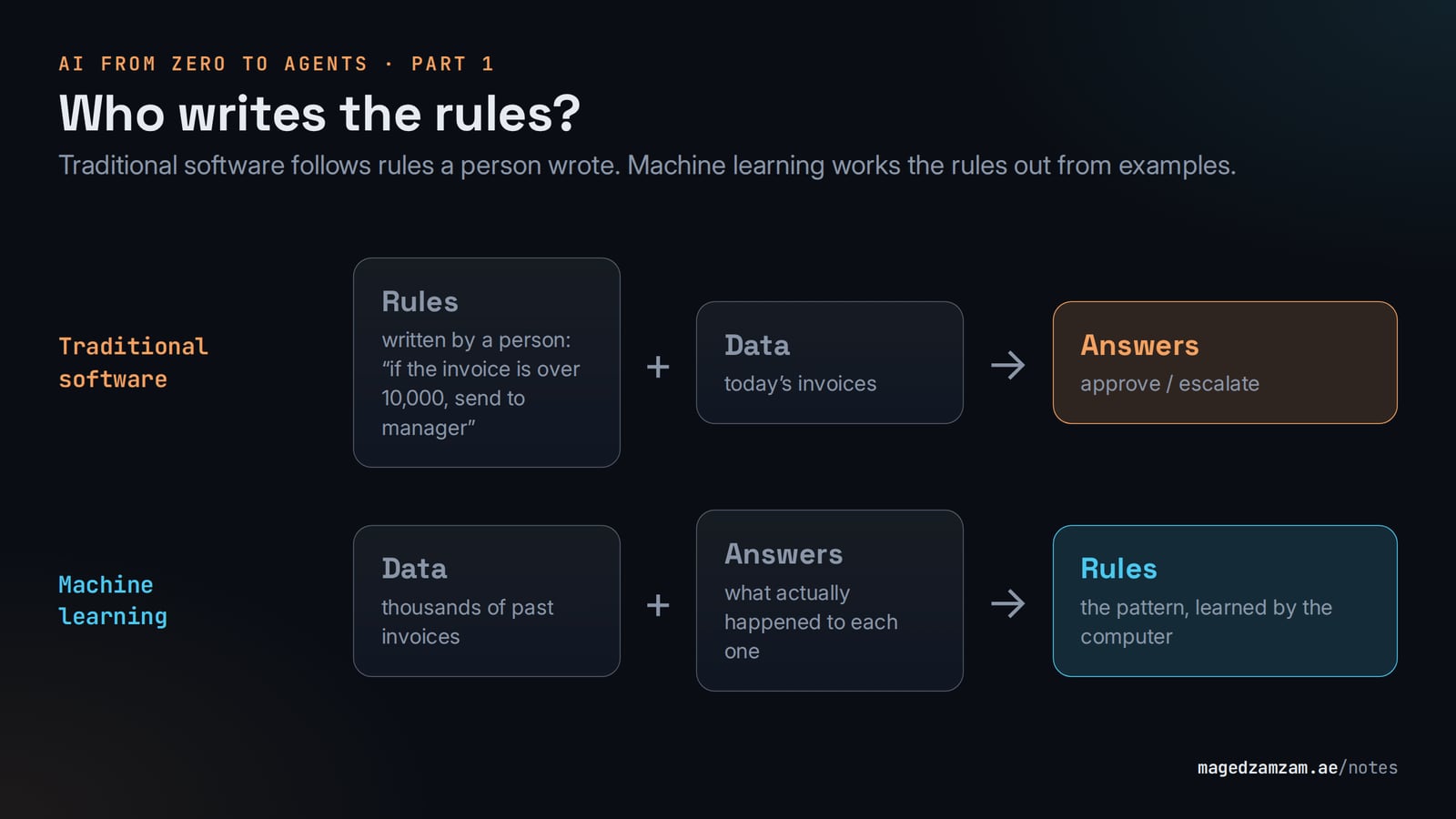
Most software you've used is basically a recipe someone wrote down. "If the invoice is over 10,000, send it to the manager." A person had to think of that rule, and every other rule, in advance.
AI turns that around. Instead of writing the rules, you show the software thousands of past invoices along with what happened to each one, and it works out the pattern for itself. Often it picks up patterns nobody would have thought to write down in the first place.
AI, ML, deep learning, generative AI: which is which?
People throw these four terms around as if they were rival products. They aren't. They sit inside each other, a bit like Russian dolls.
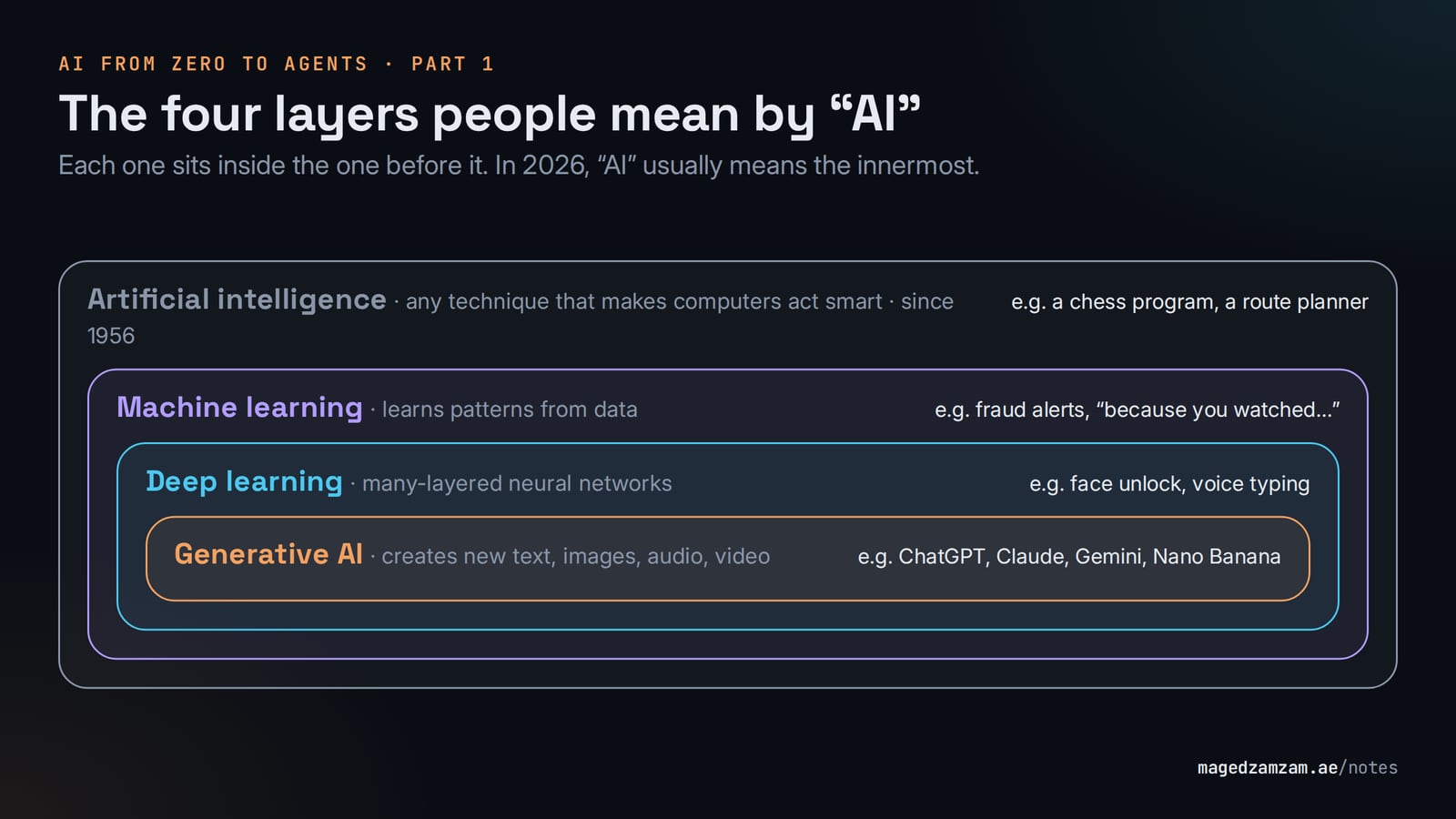
The biggest doll is artificial intelligence itself, the whole field of getting computers to do things we'd call smart. The term goes back to 1956. Inside that sits machine learning, the part of AI that learns from data rather than hand-written rules. Your bank's fraud alerts and Netflix's "because you watched…" row are both machine learning.
One layer further in is deep learning, which is machine learning built from large, many-layered "neural networks" (loosely inspired by the brain, though I wouldn't push the comparison too far). It's the reason your phone can recognise your face and turn your voice notes into text.
And right in the middle is generative AI: deep learning that creates something new, whether that's text, images, music, video or code. ChatGPT, Claude, Gemini and all those image tools filling your social feeds live here. When people say "AI" in 2026, nine times out of ten this innermost doll is what they mean.
Why does it feel like it appeared overnight?
It didn't, really. AI is roughly 70 years old. What changed is that three things finally lined up at the same time.
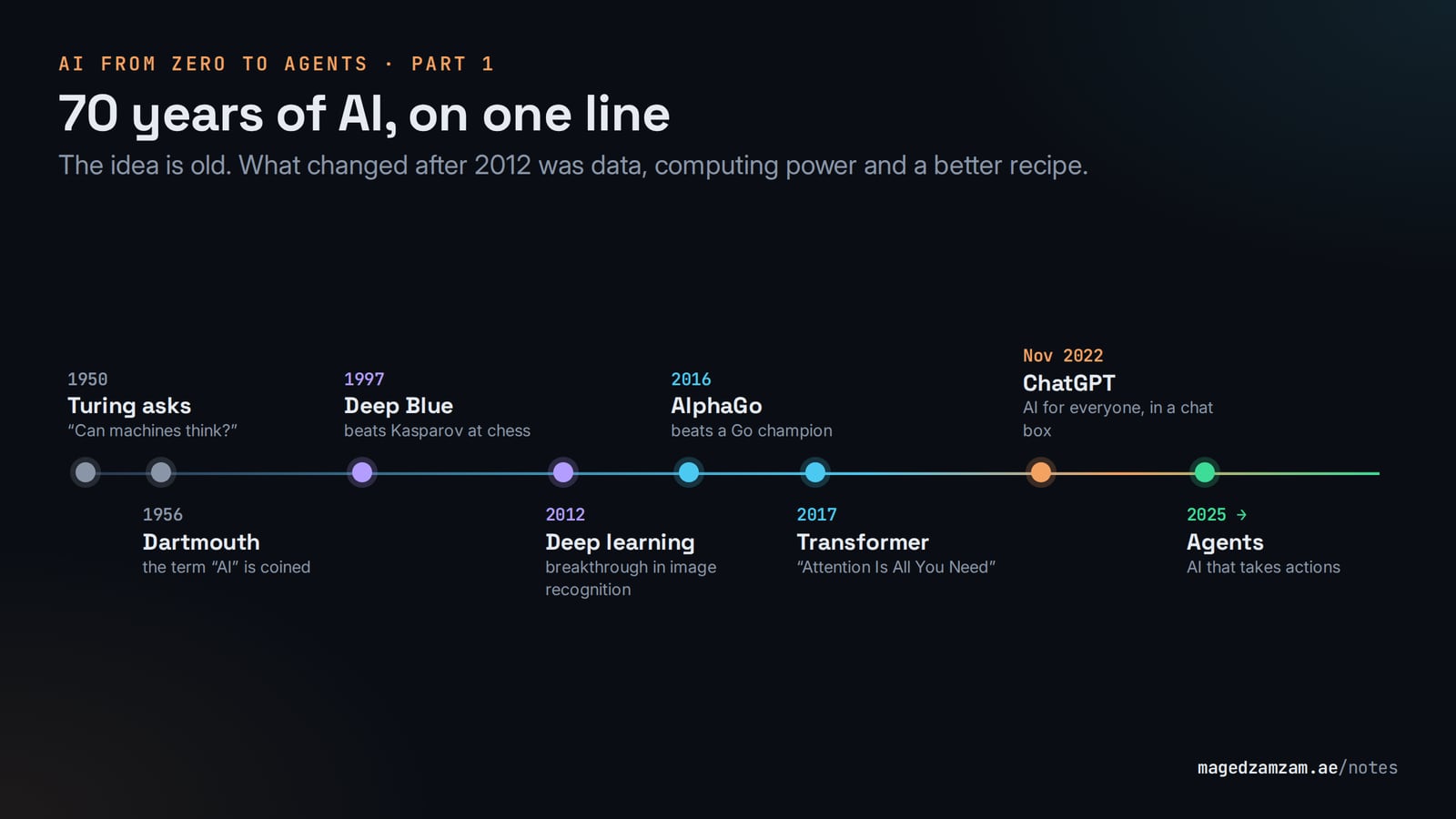
The first was data. The internet quietly became the biggest library humans have ever built, and machines can read it. The second was computing power, and here the unsung heroes are graphics chips (GPUs). They were designed for video games, and it turned out they were also brilliant at training neural networks.
The third was a better recipe. In 2017 a group of Google researchers published a paper called "Attention Is All You Need", which introduced a design called the Transformer. It reads a whole passage at once and works out which words matter to which. Almost every chatbot you use today descends from that paper, and the "T" in ChatGPT literally stands for Transformer.
Then on 30 November 2022, OpenAI put ChatGPT online as a free website, and for the first time anyone could talk to a large AI model in plain English. It reportedly hit 100 million users in about two months, faster than any consumer app before it. That's the moment most people remember as "when AI arrived".
What it's good at, and where it trips up
When customers ask me what today's AI can actually do, I usually sketch something like this:
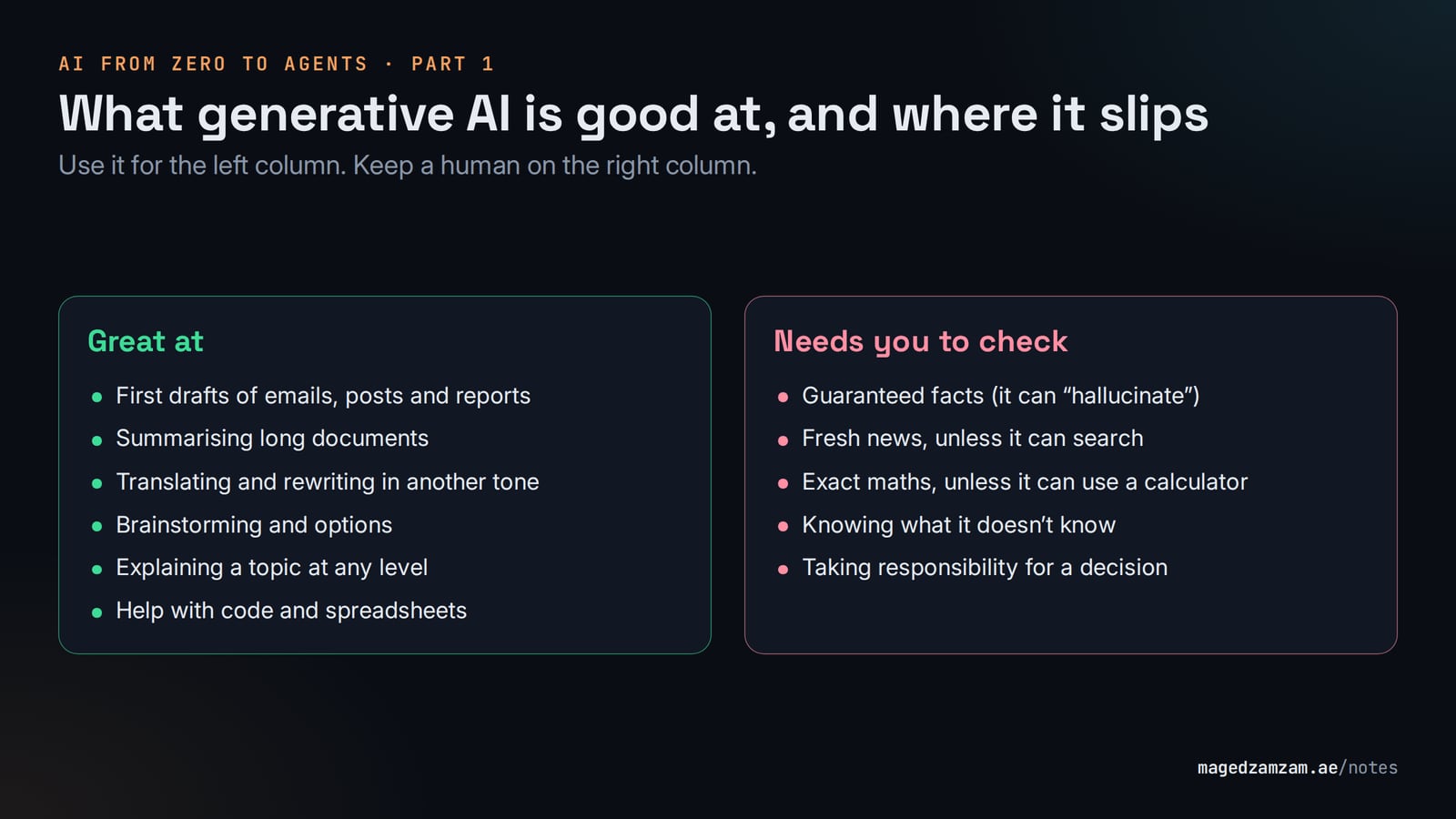
If you remember one line from that card, make it this: AI can sound completely sure of itself while being completely wrong. The industry calls this a hallucination. It isn't lying, exactly. It's producing the answer that sounds most plausible, and plausible isn't the same as true. Part 2 explains why that happens.
My working rule is to treat AI like a very bright, very fast intern. It's great at first drafts, at explaining things and at spotting patterns, but you'd still want to check its work before it goes anywhere near a customer.
You've probably used it already today
Most of us bump into AI several times a day without noticing:
| Where you met it | What the AI is doing | Which doll |
|---|---|---|
| Your inbox's spam filter | Spotting patterns in junk mail | Machine learning |
| Face unlock on your phone | Recognising your face | Deep learning |
| Maps estimating your arrival time | Predicting traffic from millions of trips | Machine learning |
| Asking a chatbot to rewrite an email | Generating new text | Generative AI |
| Turning a photo into a cartoon | Generating a new image | Generative AI |
And here's what the front door to generative AI looks like these days. It's almost comically simple: a box that waits for you to type something.
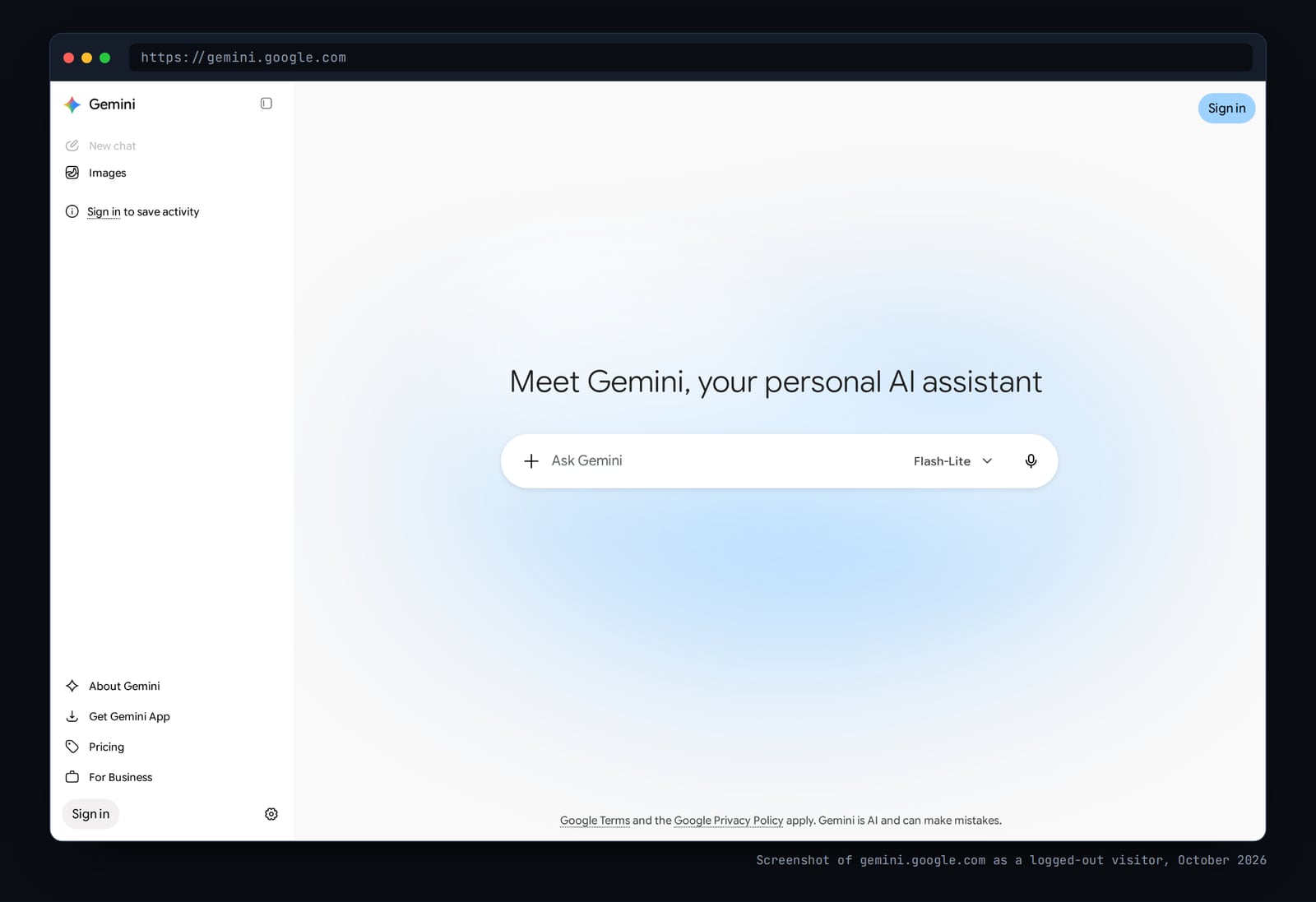
A few words will keep coming up in this series, so here they are once. A model is the trained "brain" file the software runs (Part 3 is all about models). Training is the expensive, one-off process of feeding the model huge amounts of examples. A prompt is simply whatever you type to it.
A five-minute experiment
Open any free AI assistant you like (ChatGPT, Claude, Gemini, it really doesn't matter) and paste this in:
Explain what you are and how you work to a curious 12-year-old, in five sentences. Then tell me two things you are bad at.
You'll probably find the explanation is very good, and the "things I'm bad at" list is surprisingly honest. That's roughly the relationship I'd like you to have with these tools by the end of the series: lean on the strengths, and know where the limits are.
Next time, in Part 2, we open the box and look at how a large language model actually writes, one word at a time, and why that explains both how clever it seems and why it sometimes makes things up.
More notes

Why a 100% SLA isn't feasible in technology
A customer asked me why the cloud provider doesn't just replicate everything to another region and promise 100% uptime. The honest answer has more to do with physics, change and regulators than with greed.

Hotels Need an Event Backbone, Not Another Dashboard
A vendor-neutral hospitality integration pattern using OCI APIs, streaming and operational data governance.

A backup you haven't restored is a hope, not a backup
What recovering a corrupted HR system with zero data loss in a day and a half taught me — and the HA/DR checklist I now use for every design.