Not All AI Is the Same Brain: Meet the Model Family
Part 3 of AI From Zero to Agents. What an AI “model” really is, why every vendor sells a big, medium and small version, how to read names like Opus, Sonnet, Haiku or Flash, and how text, image, voice and video models differ.
Series · AI From Zero to AgentsPart 3 of 9
- 1 AI for Newbies: The 10-Minute Guide That Finally Makes It Click
- 2 ChatGPT Isn't Magic, It's Autocomplete on Steroids
- 3 Not All AI Is the Same Brain: Meet the Model Family
- 4 ChatGPT vs Claude vs Gemini vs Grok vs Llama vs Perplexity: Which AI Should You Actually Use?
- 5 Free, Open and on Your Laptop: Open-Source Models and the Secret Currency Called Tokens
- 6 From Chatbot to Coworker: What Agentic AI Is and How to Build Your First Agent
- 7 Stop Prompting, Start Automating: AI Workflows That Save You Hours Every Week
- 8 The USB-C Moment for AI: MCP vs A2A vs ACP, and How Agents Talk to Each Other
- 9 Let's Build It: A Hands-On Agent-to-Agent Walkthrough

"Which AI do you use?" sounds like a simple question, but there are really two questions hiding in it. The first is which app: ChatGPT, Claude, Gemini, Grok, Perplexity and so on. The second is which model is running inside that app.
Most people only ever think about the first. The second is the one that decides how smart, how fast and how expensive your answer is, and most apps quietly let you switch models from a little menu at the top of the chat.
In Part 2 I called the LLM the engine. Consider this part a walk round the showroom.
What a model actually is
A model is a file full of learned numbers (the parameters), plus the instructions for running them. Training produces that file once, at huge cost. After that, every question you ask is just the model being run, which costs a tiny amount each time. The technical word for running it is inference, in case you hear it in a meeting.
The analogy I tend to use is an encyclopaedia. Training is writing and printing it. Running the model is someone looking things up in it and writing you an answer. You print once and look things up millions of times.
Why everyone sells three sizes
Bigger models are smarter, but they're slower and cost more to run. Smaller ones are quick and cheap but stumble on hard problems. So every major vendor now ships a family: a large flagship, a balanced middle option and a small, fast one.
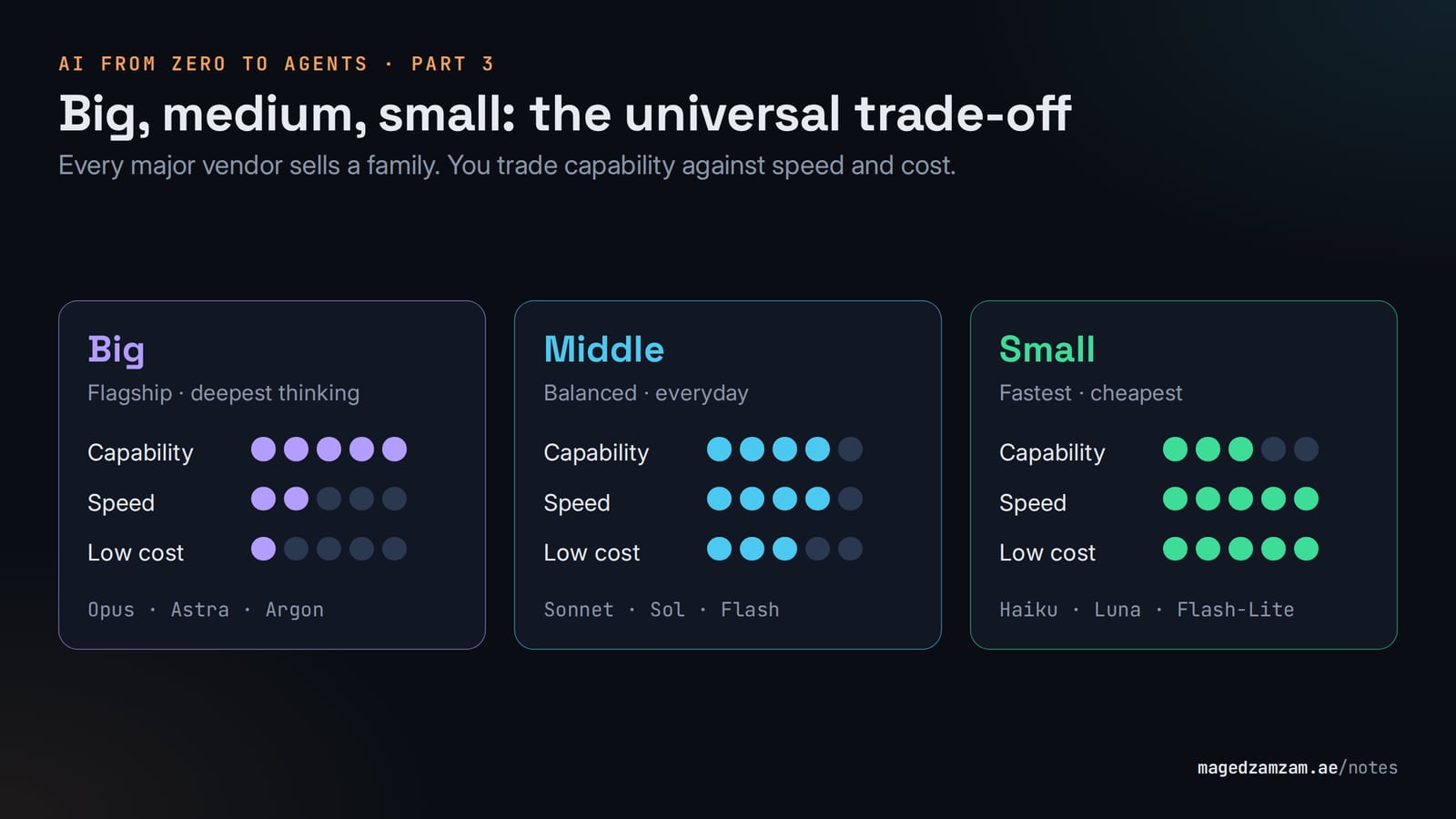
Here's how the families line up as I write this:
| Vendor | Big (deepest thinking) | Middle (everyday) | Small (fastest, cheapest) |
|---|---|---|---|
| OpenAI (ChatGPT) | GPT-6 Astra | GPT-6 Sol | GPT-6 Luna |
| Anthropic (Claude) | Claude Opus 5.5 | Claude Sonnet 5.5 | Claude Haiku 5.5 |
| Google (Gemini) | Gemini 4 Argon | Gemini 3.8 Flash | Flash-Lite tier |
| xAI (Grok) | Grok 4.7 | faster Grok variants | |
| Meta (Llama, open) | Llama 4 Maverick | Llama 4 Scout |
Last checked 21 October 2026. The names change every few months; the three-tier pattern hasn't changed in years.
On the free plans you'll usually get the middle or small model, plus a daily allowance of the big one. Paying mostly buys you more time with the flagship.
Reading a model name
Model names look like gibberish until someone shows you the pattern. Nearly all of them are four pieces glued together.
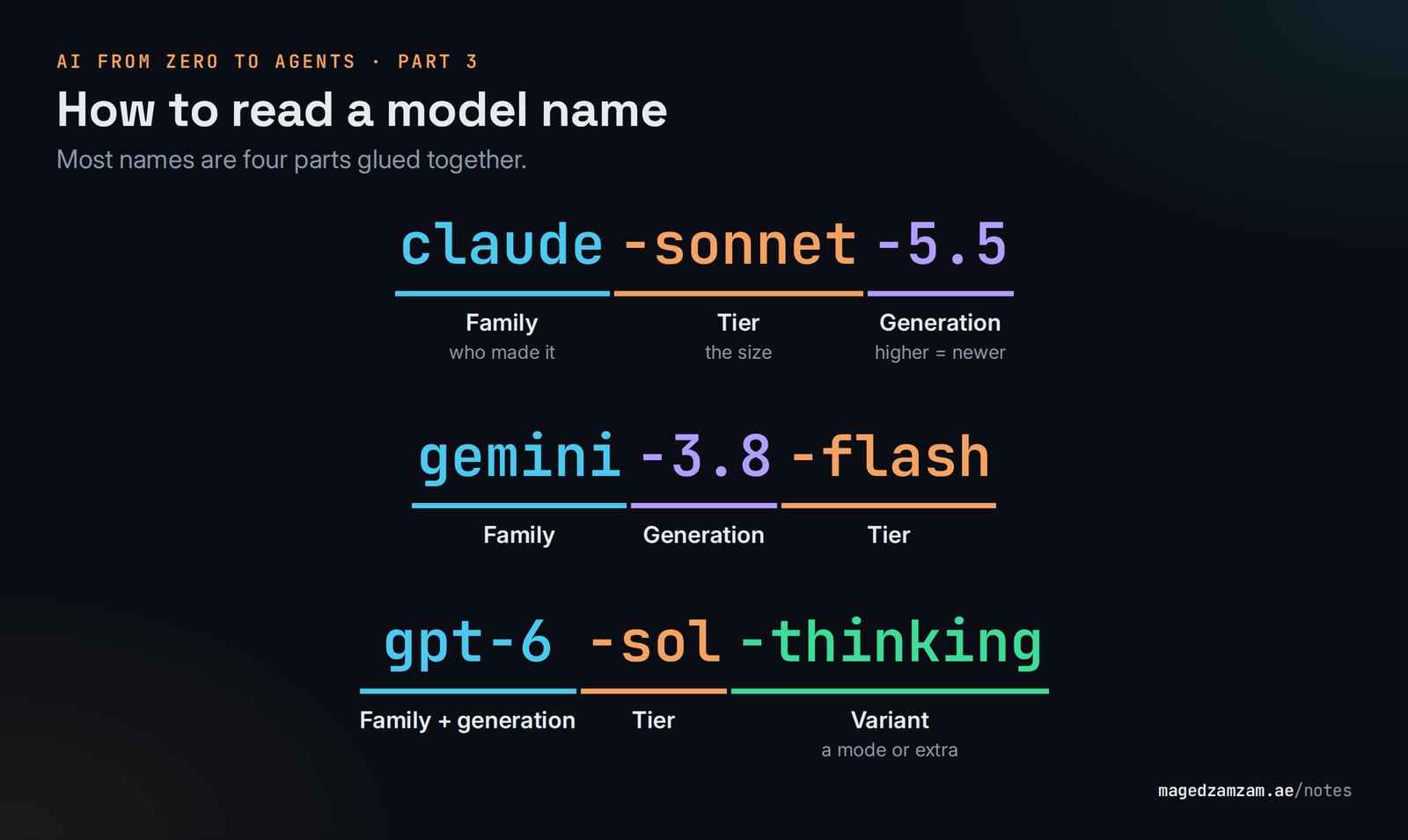
First there's the family, which tells you who made it (GPT, Claude, Gemini, Grok, Llama, Qwen, Mistral). Then a generation number, where higher usually means newer and better. Then the tier, which is the size, and here every company has its own taste: Anthropic went poetic (Opus, Sonnet, Haiku, from long to short), Google uses speed words like Pro, Flash and Lite, and OpenAI has tried everything from "mini" to planet names. Sometimes there's a variant on the end, such as thinking (the reasoning mode from Part 2), mini, or a release date.
It's not just text any more
"AI model" used to mean "chatbot". Generative models now cover four broad kinds of output, and the big assistants increasingly bundle them into one app.
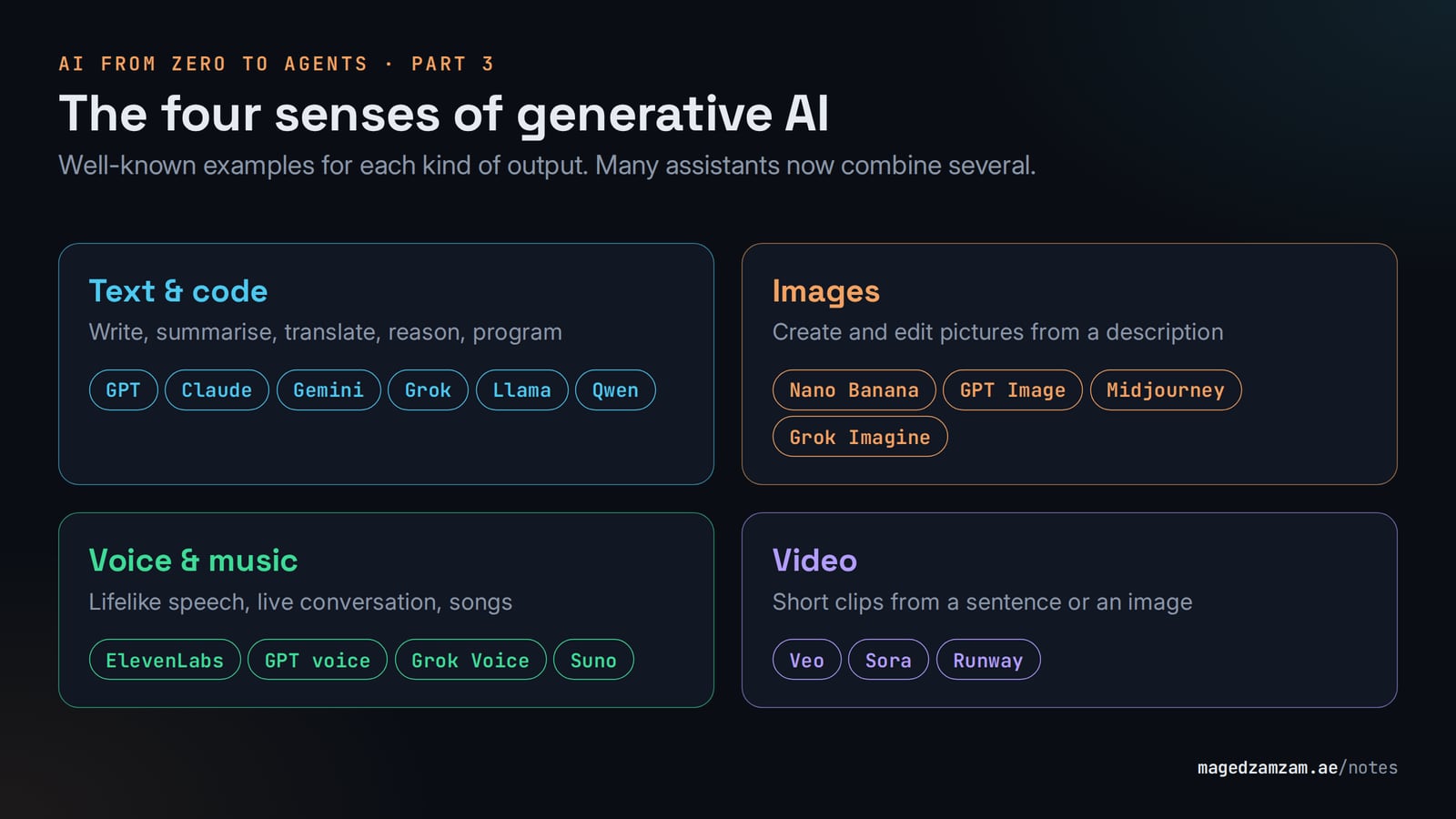
Text and code models are the LLMs from Part 2: they write, summarise, translate, reason and program. Image models create and edit pictures from a description. Google's Nano Banana family became a hit because you can edit a photo just by describing what you want changed ("put this sofa in blue velvet", say). Voice and music models produce lifelike speech in plenty of languages and accents, hold real-time spoken conversations and can even write whole songs. And video models turn a sentence or a still image into a short clip, these days with sound to match.
A model that handles more than one of these at once is called multimodal. If you've ever photographed a menu in Japanese and asked your assistant what to order, you've used one.
Bigger doesn't always win
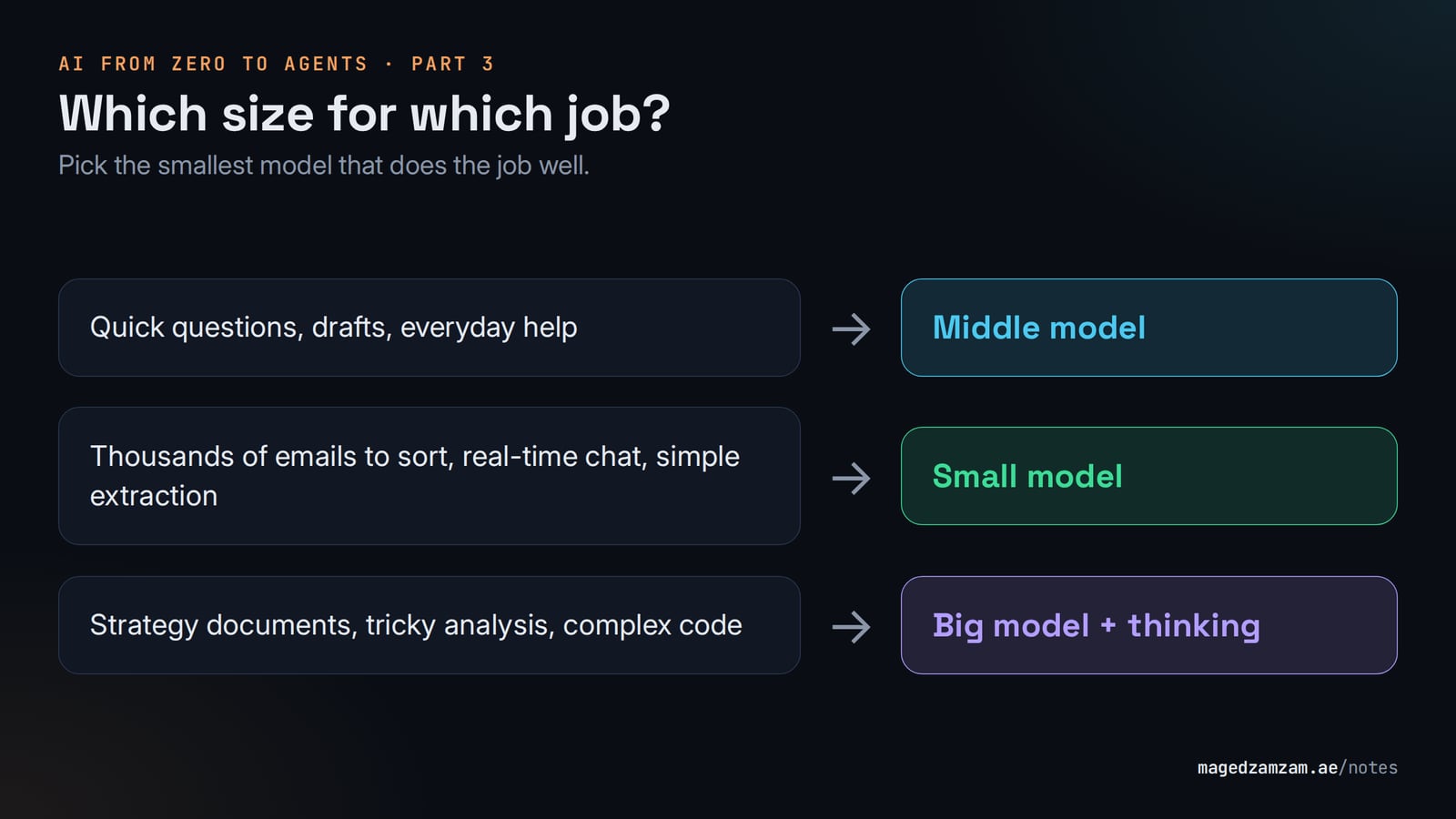
Two things surprise people here. First, today's small models often beat the flagships of two years ago, for a fraction of the cost. Second, the best model really does depend on the job. If you're sorting 10,000 support emails, a small fast model is the professional choice. For a strategy paper or a fiddly legal comparison, pay for the flagship and turn thinking on.
Try the picker
Next time you open your favourite assistant, look for the model picker (normally at the top of the chat or beside the message box). Ask the smallest and the biggest model on offer the same slightly tricky question, something like:
I have 3 meetings: 9-10, 9:30-11 and 10:45-12. What's the minimum number of rooms I need, and why?
Notice the difference in speed, and in how well each one explains itself. That's the table above playing out in front of you.
Part 4 is the one I get asked about most: ChatGPT vs Claude vs Gemini vs Grok vs Llama vs Perplexity, side by side, with real screenshots and a look at the specialist tools for images, voice, video and research.
More notes

Why a 100% SLA isn't feasible in technology
A customer asked me why the cloud provider doesn't just replicate everything to another region and promise 100% uptime. The honest answer has more to do with physics, change and regulators than with greed.

Hotels Need an Event Backbone, Not Another Dashboard
A vendor-neutral hospitality integration pattern using OCI APIs, streaming and operational data governance.

A backup you haven't restored is a hope, not a backup
What recovering a corrupted HR system with zero data loss in a day and a half taught me — and the HA/DR checklist I now use for every design.