ChatGPT vs Claude vs Gemini vs Grok vs Llama vs Perplexity: Which AI Should You Actually Use?
Part 4 of AI From Zero to Agents. My side-by-side of the big AI assistants with real screenshots, a “best for” matrix and a quick decision guide, plus the specialists worth knowing for images, voice, video and research: Nano Banana, Midjourney, ElevenLabs, Veo and Gemini Notebook.
Series · AI From Zero to AgentsPart 4 of 9
- 1 AI for Newbies: The 10-Minute Guide That Finally Makes It Click
- 2 ChatGPT Isn't Magic, It's Autocomplete on Steroids
- 3 Not All AI Is the Same Brain: Meet the Model Family
- 4 ChatGPT vs Claude vs Gemini vs Grok vs Llama vs Perplexity: Which AI Should You Actually Use?
- 5 Free, Open and on Your Laptop: Open-Source Models and the Secret Currency Called Tokens
- 6 From Chatbot to Coworker: What Agentic AI Is and How to Build Your First Agent
- 7 Stop Prompting, Start Automating: AI Workflows That Save You Hours Every Week
- 8 The USB-C Moment for AI: MCP vs A2A vs ACP, and How Agents Talk to Each Other
- 9 Let's Build It: A Hands-On Agent-to-Agent Walkthrough

If I had a dirham for every time someone asked me "which AI should I use?", I could retire. It comes up at conferences, in customer meetings and, most persistently, in the family WhatsApp group.
My short answer is always the same: use whichever one fits the job, and don't feel guilty about using two. The long answer is this article. In Part 3 we looked at the engines; now we take the cars for a test drive.
Everything below was last checked on 21 October 2026. This market moves monthly, so I've focused on each product's personality (which changes slowly) rather than version numbers (which change constantly).
Meet the contenders
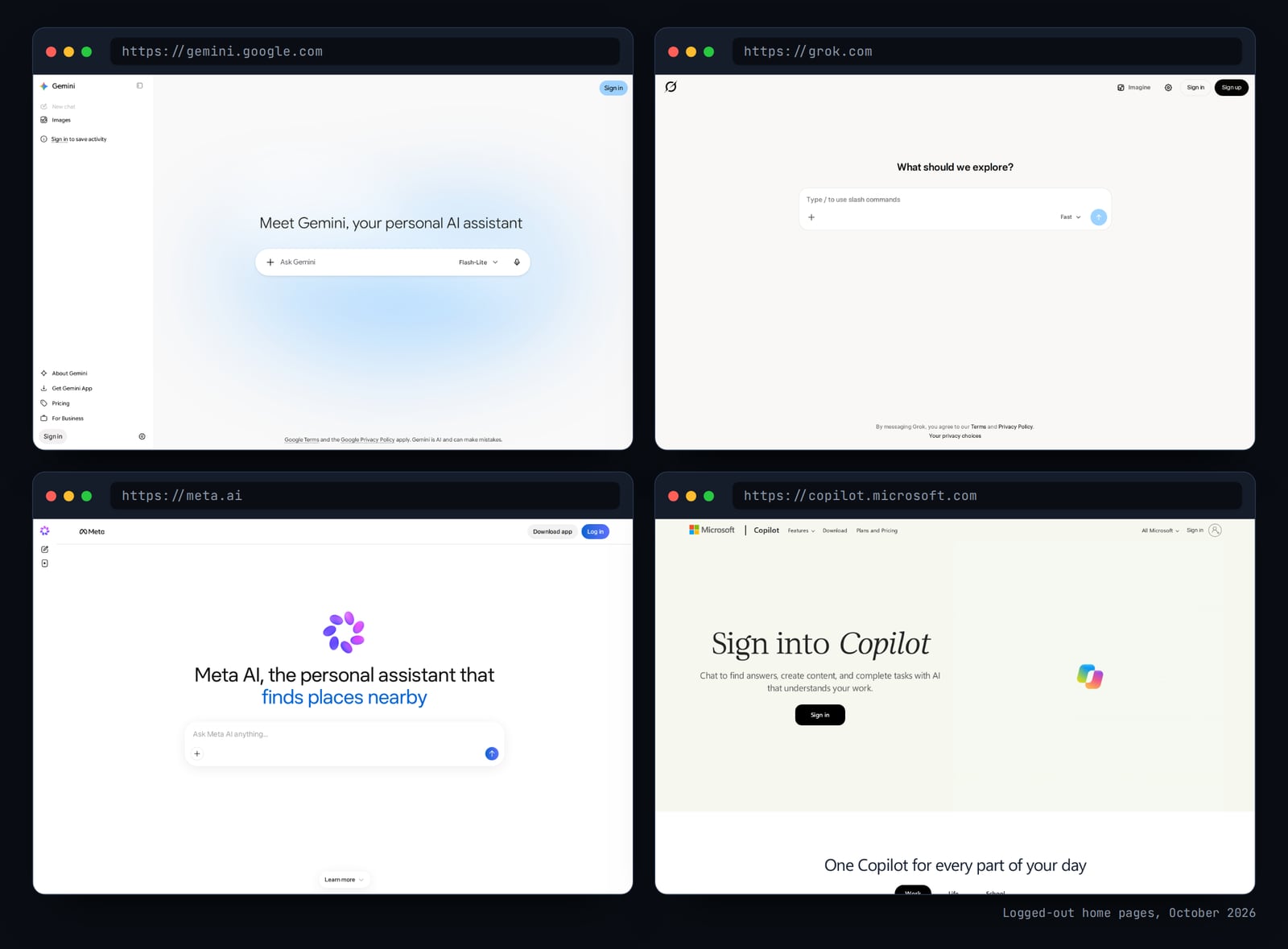
You'll notice they all look alike: a text box, a model picker, a microphone and a paperclip. That's no accident. The real differences sit underneath.
ChatGPT (OpenAI): the all-rounder
The one that started the whole thing, and still the most widely used. Its newest engine, GPT-6, arrived in October 2026 with something OpenAI calls "Intelligent UI", which means it can now build charts, tables and small interactive tools inside an answer instead of just replying with text. Add image generation, voice conversation, memory, custom GPTs and an agent mode that browses and finishes tasks for you, and it's hard to find something it can't at least have a go at. If you only want one assistant in your life, this is the safe pick.
Claude (Anthropic): the writer and the coder
Claude has a reputation for writing that actually sounds like a person wrote it, and for staying sharp across very long documents. Projects keep your files and instructions in one place, and artifacts turn an answer into a document, small app or diagram that opens beside the chat. Software developers love it too. I reach for it when I've got a fat contract or report to pick apart, or something that needs to read well.
Gemini (Google): plugged into your Google life
Gemini's trick is that it already lives where a lot of us work: Gmail, Docs, Drive, Calendar, Maps, YouTube and Android. It's also very strong on pictures and video, with the Nano Banana image models and Veo built in, and it copes happily with very long inputs. If your day runs on Google Workspace or an Android phone, start here.
Grok (xAI): the one reading the news feed
Grok is built into X (formerly Twitter) and can see what people are posting right now. It has a deliberately cheekier personality than the others, plus its own image and video generator, and its latest model, Grok 4.7, landed in September 2026. It's the one to ask when you want to know what's trending and what people are saying about it.
Perplexity: the research librarian
Perplexity calls itself an answer engine, and that's fair. Every reply is built from live web searches, with numbered sources you can click and check. Paid users can switch between engines from other vendors behind the scenes, and there's now an AI browser too, called Comet. When I need to see where a claim came from, this is where I go.
Meta AI and Llama: already in your pocket
Meta AI sits inside WhatsApp, Instagram and Messenger, so millions of people use it without ever installing anything. Behind it is Meta's Llama family, which is released as open weights, meaning anyone can download it and run it themselves (Part 5 explains why that's a bigger deal than it sounds). It's handy for quick help inside apps you already have open, and for builders it's a free model you can host on your own kit.
A few honourable mentions. Microsoft Copilot is built into Windows and Microsoft 365, so it's the obvious choice if your company runs on Office. Mistral's Le Chat is a fast European alternative. DeepSeek and Qwen are strong, low-cost Chinese models, and both also publish open weights.
Who's best at what
This grid is my opinion after using all of them daily for work, nothing more scientific than that. You'll probably disagree with a square or two, which is fine. Try them on your own tasks.
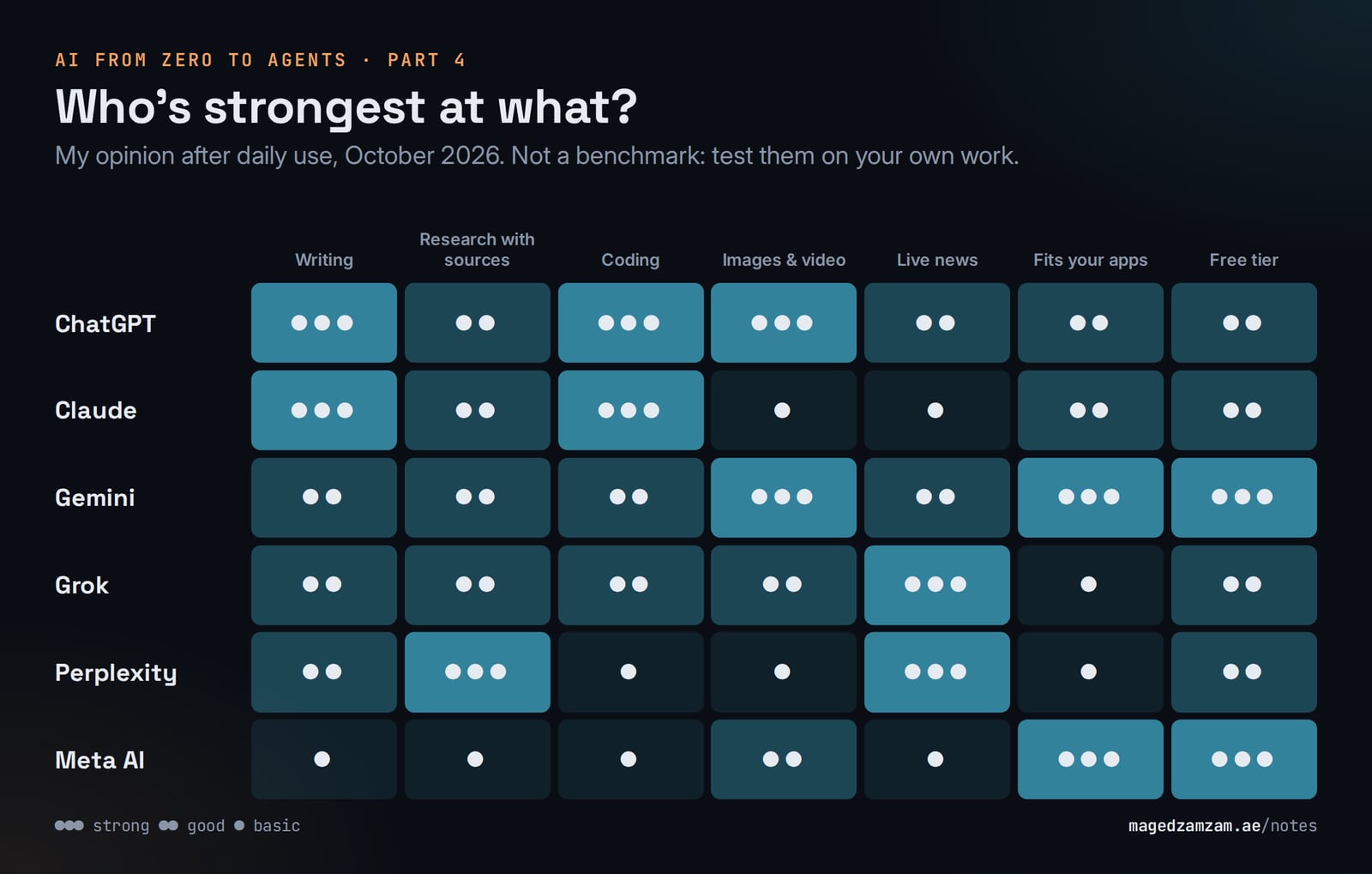
If you'd rather have numbers than my opinion, have a look at public leaderboards such as LMArena (now at arena.ai), where thousands of people vote blind between two anonymous answers. The top spot changes hands every few weeks, which tells you nobody has a permanent lead.
If you've only got a minute
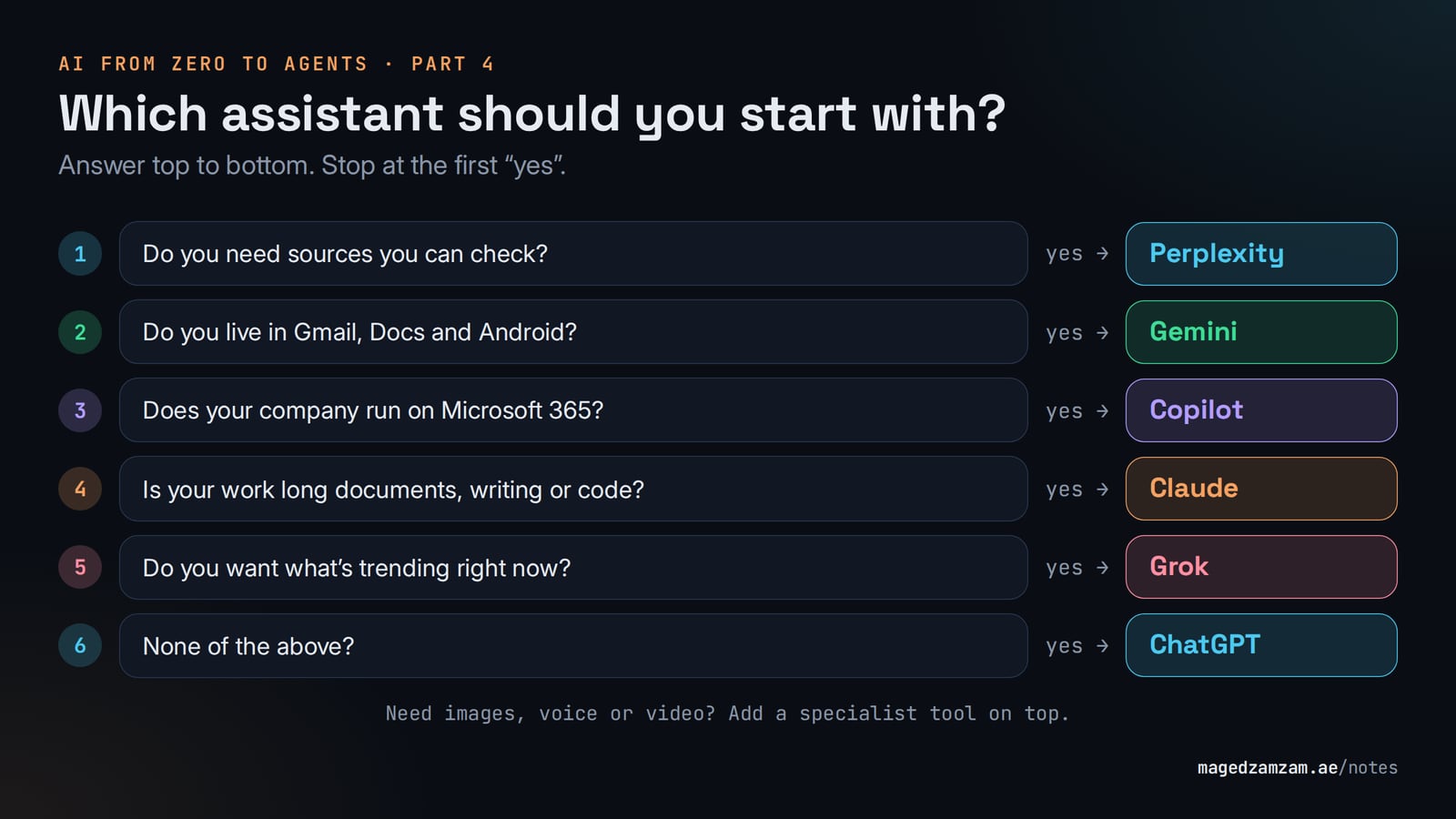
On money: every one of them has a free tier, and that's plenty while you're learning. The standard paid plans sit around US$20 a month, and the premium tiers for heavy users cost a lot more. My advice is to pay for one, not five. Subscribe to the one you find yourself opening most, and use the free tiers of the rest.
The specialists
The big assistants are generalists. For a handful of jobs a specialist still does it better.
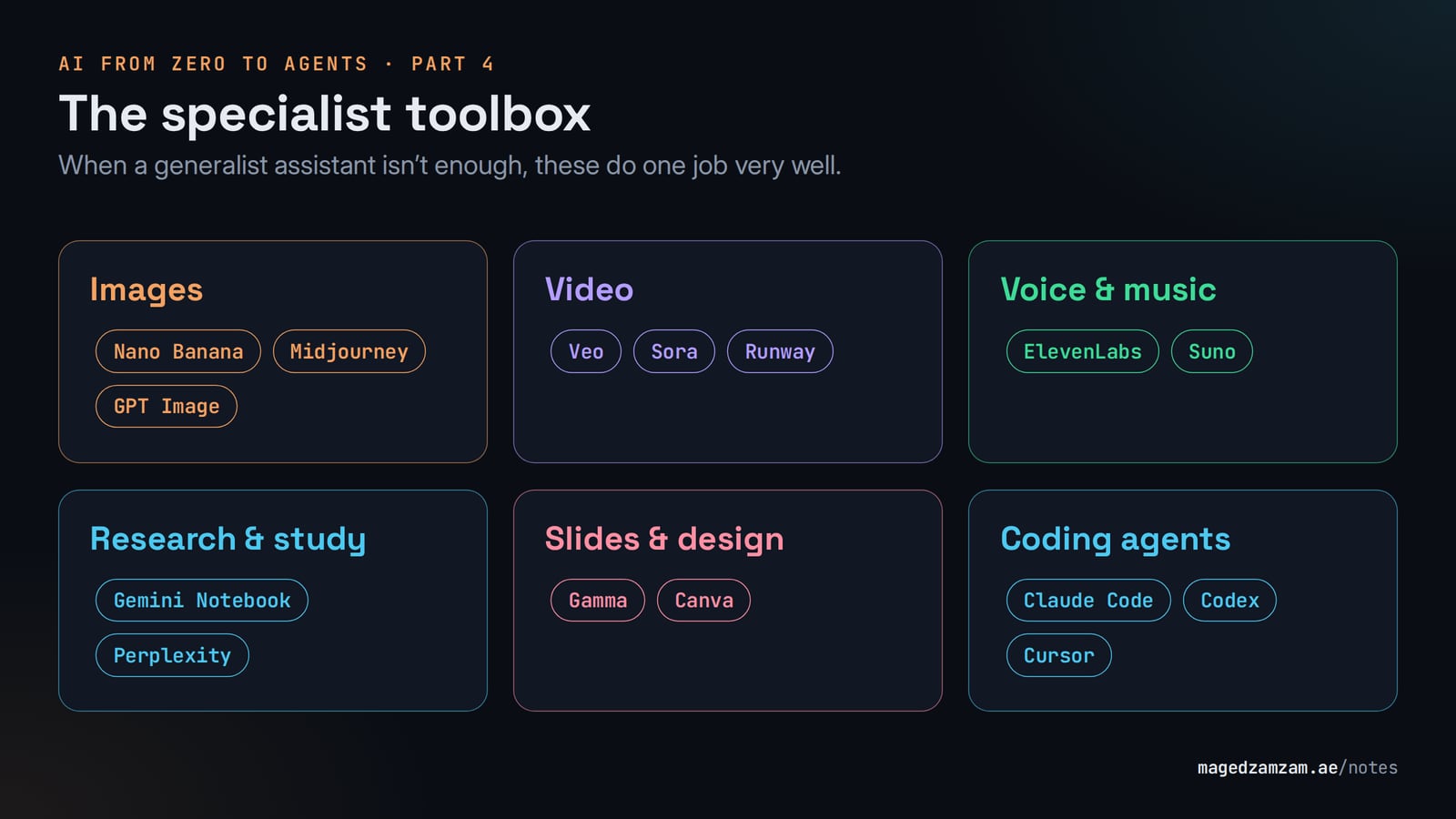
Nano Banana, Google's image model, is the one that went viral, and for good reason. You upload a photo, describe the change ("make it sunset", "swap the jacket for a blue one") and it keeps the person and the scene consistent. It's built into Gemini. Midjourney, meanwhile, is still the artist's favourite for striking, stylised images.
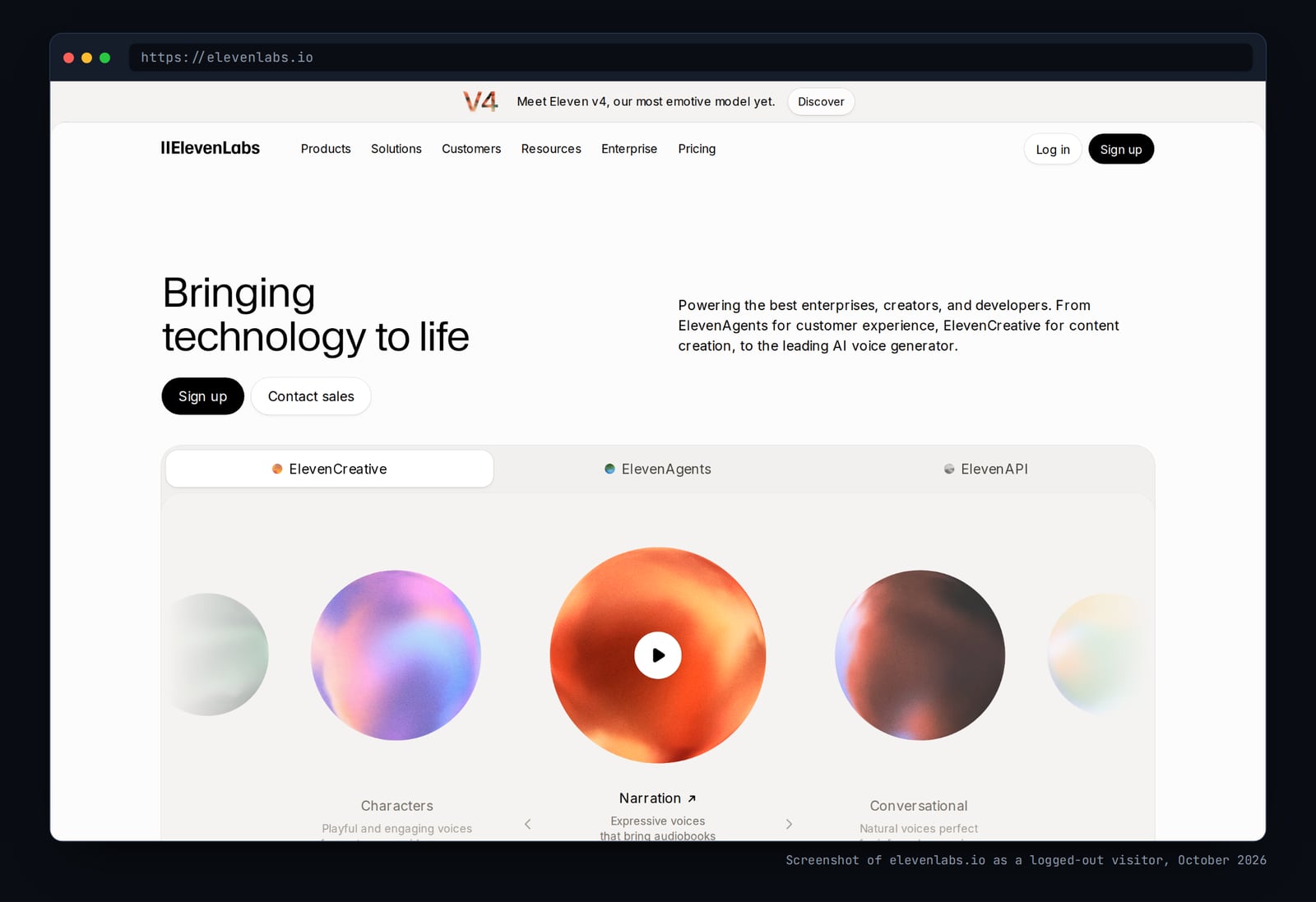
For voice, ElevenLabs produces remarkably lifelike speech and dubbing in dozens of languages, Arabic included, which is why you hear it in narration, podcasts and translated training videos. On the video side, Veo, Sora and Runway turn a sentence or a still image into a short cinematic clip, now with sound.
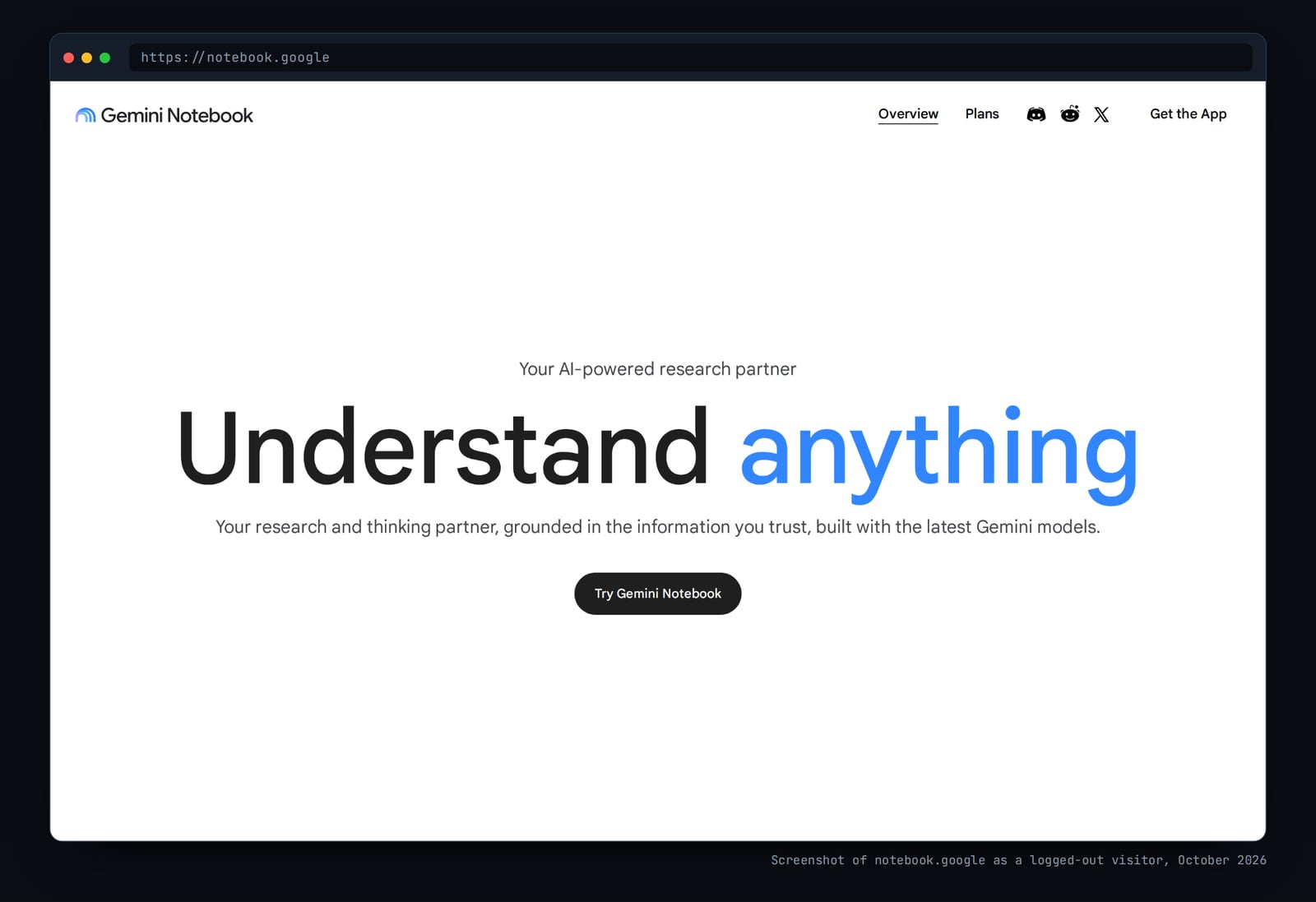
Gemini Notebook (Google's new name for NotebookLM) works differently from a chatbot: you upload your own documents and it answers only from those. It became famous for turning a pile of PDFs into a podcast-style audio summary, which is oddly addictive.
And then there are coding agents like Claude Code, Codex and Cursor. They don't just suggest code; they edit whole projects. Consider them a preview of Part 6.
Before you paste anything
One warning before you drop a customer list or a contract into any of these. Check whether you're on the consumer app or a business plan, and whether your data is used for training. Business and enterprise plans usually promise not to train on your data and give admins proper controls. Consumer plans vary, and most have a setting to opt out. If in doubt, use whatever your company has approved.
Your homework
Run the same prompt in three different assistants and compare what comes back:
I'm visiting Dubai for 48 hours in December with two kids aged 8 and 12. Plan both days with timings, a budget estimate in AED, and one indoor backup for each outdoor activity. List your sources.
Notice who asked you clarifying questions, who gave sources, whose plan felt like it was made by someone who's actually been to Dubai, and whose formatting you liked. You'll have a favourite inside ten minutes, and that's worth more than any review (this one included).
Next time, in Part 5, we look at open models you can run on your own laptop with the Wi-Fi switched off, and at tokens, the odd little unit that every AI bill is quietly measured in.
More notes

Why a 100% SLA isn't feasible in technology
A customer asked me why the cloud provider doesn't just replicate everything to another region and promise 100% uptime. The honest answer has more to do with physics, change and regulators than with greed.

Hotels Need an Event Backbone, Not Another Dashboard
A vendor-neutral hospitality integration pattern using OCI APIs, streaming and operational data governance.

A backup you haven't restored is a hope, not a backup
What recovering a corrupted HR system with zero data loss in a day and a half taught me — and the HA/DR checklist I now use for every design.